

Curing is the process of maintaining adequate moisture and proper temperature in freshly placed concrete for a certain period to allow cement hydration to continue effectively. Hydration is the chemical reaction between cement and water that causes concrete to gain strength and harden over time. If concrete loses moisture too quickly due to heat, wind, or dry conditions, the hydration process slows down or stops, resulting in weak and crack-prone concrete.
Curing helps prevent premature drying by keeping the concrete surface moist and protected during its early stages. It is important to note that curing is different from setting and hardening. Setting is the initial stiffening of concrete, while hardening is the gradual development of strength. Proper curing supports both processes and ensures improved strength, durability, surface quality, and long-term performance of concrete structures.
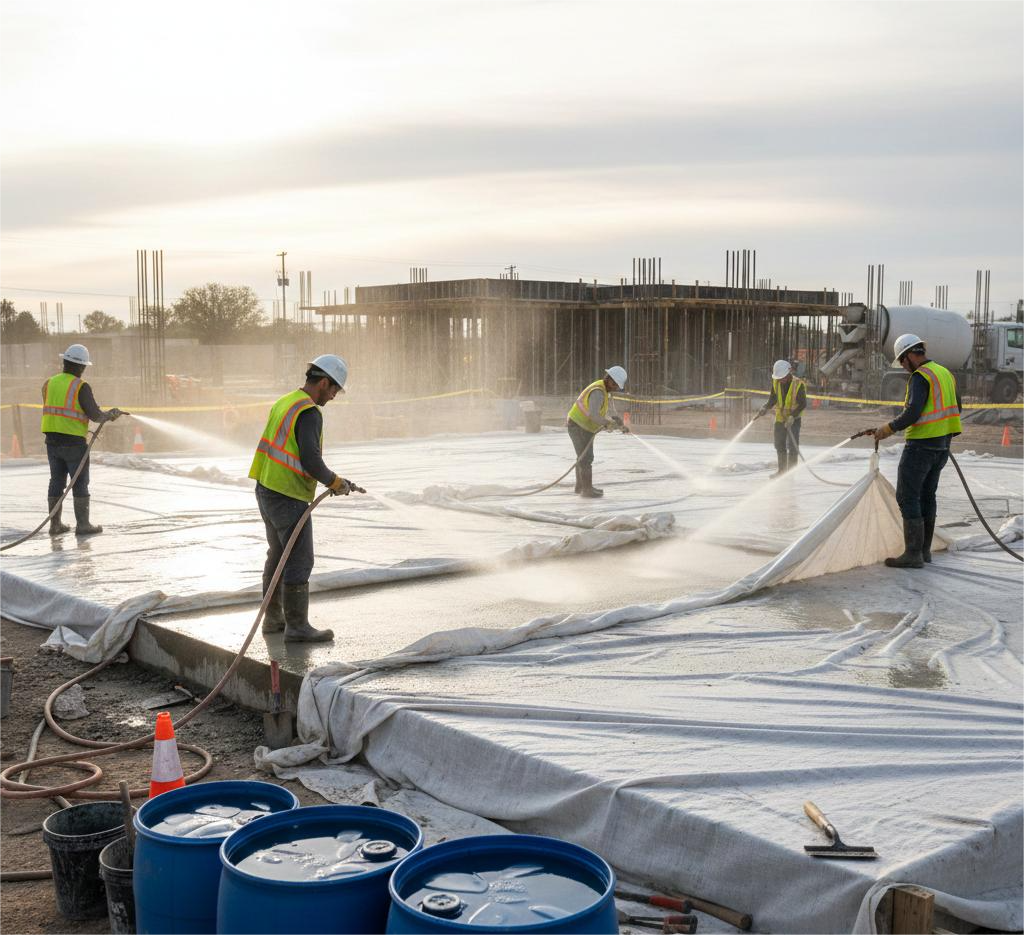
Importance of Curing in Construction
Strength Development
Proper curing plays a vital role in achieving the designed strength of concrete and ensuring its long-term performance. When concrete is cured under adequate moisture and temperature conditions, the cement continues to hydrate effectively. This hydration process allows cement particles to form strong bonds with aggregates, resulting in a dense and well-integrated concrete matrix. As a result, properly cured concrete develops significantly higher compressive strength compared to concrete that is poorly cured or left untreated.
Continuous curing prevents premature moisture loss, which is one of the main causes of incomplete hydration. If concrete dries too quickly, the hydration process stops early, leading to reduced strength and increased porosity. In such cases, concrete may appear hard and set on the surface, but the internal structure remains weak and brittle. This hidden weakness can cause serious structural deficiencies over time, including cracking, load failure, and reduced durability.
Adequate curing also ensures uniform strength development throughout the concrete element, minimizing weak zones and internal stresses. This is especially important for load-bearing members such as slabs, columns, beams, and foundations, where strength consistency is critical. By ensuring proper curing, construction professionals can achieve the intended design strength, improve structural reliability, and enhance the overall safety and performance of concrete structures.
Durability of Concrete
Curing directly affects the durability and long-term performance of concrete structures. When concrete is properly cured, it develops a dense and well-bonded internal structure that significantly reduces permeability. Lower permeability limits the penetration of water, chlorides, sulfates, and other harmful chemicals that can weaken concrete and corrode embedded reinforcement. This protective effect is especially important in environments exposed to moisture, chemicals, or extreme weather conditions.
Well-cured concrete also shows improved resistance to weathering and freeze–thaw cycles. In cold climates, trapped water inside poorly cured concrete can freeze and expand, leading to surface scaling, cracking, and gradual deterioration. Proper curing minimizes this risk by reducing internal voids and ensuring sufficient strength development. Additionally, curing enhances resistance to chemical attacks from industrial waste, soil contaminants, and de-icing salts, all of which can severely damage uncured or poorly cured concrete.
In infrastructure projects such as bridges, pavements, retaining walls, and foundations, durability is just as critical as strength. These structures are continuously exposed to traffic loads, environmental stress, and aggressive agents. Without proper curing, premature deterioration can occur, leading to costly repairs and reduced service life. Therefore, effective curing is not merely a quality measure but an essential construction practice for achieving long-lasting, durable, and reliable concrete structures.
Crack Prevention
Crack prevention is one of the most important reasons why proper curing is essential in concrete construction. When freshly placed concrete loses moisture too quickly, the hydration process is interrupted, causing the surface to shrink faster than the interior. This uneven moisture loss leads to common defects such as plastic shrinkage cracks, which appear in the early stages, and drying shrinkage cracks that develop as concrete hardens over time. These cracks may seem minor at first, but they can significantly weaken the structure if left unaddressed.
Cracks in concrete do more than affect the visual appearance of a structure. They create pathways for water, air, and aggressive chemicals to penetrate the concrete, which can accelerate reinforcement corrosion and reduce overall durability. Over time, this can result in reduced load-bearing capacity, increased maintenance costs, and a shorter service life of the structure.
Proper curing plays a critical role in minimizing these risks. By maintaining adequate moisture levels and controlling temperature, curing allows uniform hydration throughout the concrete mass. This balanced hydration reduces internal stresses caused by rapid drying and volume changes. As a result, the concrete gains strength gradually and evenly, significantly lowering the chances of cracking. Effective curing ensures stronger, more durable, and crack-resistant concrete structures.
Improved Surface Finish
Curing plays a crucial role in enhancing the surface quality and overall finish of concrete. When concrete is properly cured, it retains sufficient moisture for continuous cement hydration, which leads to the formation of a dense and well-bonded surface layer. This dense surface significantly improves hardness and reduces common surface defects such as dusting, scaling, and early surface wear. Poor or inadequate curing, on the other hand, causes rapid moisture loss from the surface, resulting in weak, powdery, or flaky concrete that deteriorates quickly under traffic or environmental exposure.
A well-cured concrete surface also provides better resistance to abrasion and impact, making it more suitable for areas subjected to frequent use. This is particularly important for slabs, pavements, industrial floors, footpaths, and exposed concrete elements where appearance and performance are equally important. Proper curing helps maintain uniform color and texture, preventing surface discoloration and patchy finishes that often occur due to uneven moisture loss.
In addition, good curing practices reduce the chances of surface cracks, which can compromise both aesthetics and durability. By maintaining consistent moisture and temperature during the early stages, curing ensures a smooth, strong, and long-lasting surface. As a result, structures require fewer surface repairs and maintenance, leading to better long-term performance and cost efficiency.
Cost Efficiency and Structural Performance
Although curing requires additional time, labor, and resources during the construction phase, it plays a crucial role in reducing long-term costs and improving overall structural performance. Proper curing allows concrete to achieve its intended strength and durability, minimizing the risk of early-age defects such as cracking, surface scaling, and reduced load-bearing capacity. When concrete is cured correctly, it develops a dense and compact structure that resists moisture penetration, chemical attack, and environmental wear.
Poorly cured concrete, on the other hand, often leads to premature deterioration, frequent repairs, and higher maintenance expenses. Issues such as reinforcement corrosion, surface dusting, and reduced durability can significantly increase lifecycle costs. In severe cases, inadequate curing may even result in structural failure, leading to safety risks and costly reconstruction.
By following proper curing practices, construction projects benefit from improved structural integrity and consistent performance over time. Well-cured concrete requires fewer repairs, extends the service life of structures, and reduces downtime caused by maintenance activities. Additionally, proper curing helps ensure compliance with construction standards and quality specifications, which is essential for project approvals and long-term reliability. Investing in effective curing is therefore not an added expense, but a cost-efficient strategy that enhances durability, safety, and value throughout the life of a structure.
Effects of Improper or No Curing
- Reduced Compressive Strength: Proper curing is essential for concrete to achieve its designed compressive strength. When concrete is not cured adequately, the hydration process of cement is interrupted due to early moisture loss. As a result, the concrete does not develop the internal bonding required to carry loads effectively.
Even though the surface may appear hard, the internal structure remains weak. This can significantly reduce the load-bearing capacity of columns, slabs, beams, and foundations. In structural elements, reduced compressive strength may lead to deflection, cracking under load, or failure to meet design specifications.In large construction projects, insufficient strength can also cause delays, as additional testing, strengthening, or rework may be required.
Proper curing ensures that concrete reaches its intended strength, supporting safe and reliable structural performance throughout the life of the building.These problems can affect both safety and project costs, highlighting the importance of curing as a non-negotiable construction activity.
- Increased Cracking and Surface Defects: One of the most visible consequences of improper curing is increased cracking. When concrete loses moisture too quickly, it undergoes plastic and drying shrinkage, leading to cracks on the surface.
These cracks often appear in slabs, pavements, and exposed concrete elements.Surface defects such as scaling, dusting, and uneven textures are also common in poorly cured concrete.These defects not only affect appearance but also reduce surface durability and wear resistance.
Cracks and surface damage allow water and harmful substances to penetrate deeper into the concrete, accelerating deterioration. Proper curing helps control moisture loss, reduces internal stresses, and ensures a smooth, durable surface finish.
- Higher Permeability and Water Absorption: Improper curing increases the permeability of concrete by leaving unhydrated cement particles and voids within the structure. These voids allow water, chemicals, and gases to penetrate the concrete more easily.
High water absorption makes concrete vulnerable to reinforcement corrosion, chemical attack, and freeze-thaw damage. Over time, this leads to reduced durability and structural integrity, especially in foundations, basements, and water-exposed structures.
Well-cured concrete develops a dense and compact internal structure, which significantly reduces permeability. By maintaining adequate moisture during curing, the concrete becomes more resistant to water ingress and long-term deterioration.
- Poor Resistance to Environmental Exposure: Concrete structures are constantly exposed to environmental conditions such as heat, rain, wind, pollution, and chemicals. Without proper curing, concrete lacks the strength and density needed to resist these external factors.
Poorly cured concrete is more susceptible to weathering, surface erosion, and chemical attacks. In harsh climates, this can lead to rapid deterioration, cracking, and surface damage. Structures exposed to marine environments, industrial chemicals, or extreme temperatures are particularly at risk.
Proper curing enhances concrete’s ability to withstand environmental exposure by improving its durability and resistance to external stresses. This is especially important for infrastructure projects, pavements, and exposed structural elements.
- Shortened Lifespan of Concrete Structures: The long-term performance of a concrete structure depends heavily on proper curing during its early stages. Inadequate curing accelerates deterioration and reduces the overall lifespan of the structure.
Structures with poorly cured concrete often require frequent repairs, strengthening, or early replacement. This increases maintenance costs and disrupts normal use of the facility. In extreme cases, structural safety may be compromised.
By ensuring proper curing, concrete structures achieve better strength, durability, and resistance to damage. This extends their service life, reduces long-term costs, and ensures safe and reliable performance over many years.
Methods of Curing in Construction
Several curing methods are used on construction sites, depending on the type of structure, weather conditions, and available resources.
- Water Curing: Water curing is the most widely used and effective method of curing concrete in construction projects. This method focuses on maintaining continuous moisture on the concrete surface so that cement hydration can proceed without interruption. Since hydration requires water, preventing moisture loss during the early stages of concrete hardening is essential for achieving the desired strength and durability.
In water curing, the concrete surface is kept wet by methods such as ponding, spraying, fogging, or covering with wet materials like hessian, burlap, or gunny bags. Ponding is commonly used for flat and horizontal surfaces such as slabs, floors, pavements, and roofs, where water can be retained easily. For vertical or sloped surfaces, regular spraying or wet coverings are more practical solutions.
One of the key advantages of water curing is its ability to control surface temperature and reduce drying shrinkage. By keeping the concrete moist, it minimizes the risk of plastic shrinkage cracks and surface defects. Water curing also improves surface hardness, reduces permeability, and enhances overall durability.
Although water curing requires adequate water supply and regular supervision, it remains the preferred method on most construction sites due to its simplicity, effectiveness, and reliability. When properly executed, water curing significantly improves concrete performance and ensures long-term structural integrity.
- Membrane Curing: Membrane curing is a widely used method in construction where curing compounds or impermeable coverings such as plastic sheets are applied to the concrete surface to reduce moisture loss. After the concrete has been placed and finished, a membrane is formed over the surface, which acts as a barrier and prevents rapid evaporation of water. By retaining internal moisture, membrane curing allows the cement hydration process to continue, helping the concrete gain adequate strength and durability.
This curing method is especially useful in locations where water availability is limited or where continuous wet curing is difficult to maintain. It is commonly used for large concrete surfaces such as pavements, roads, slabs, and industrial floors, where regular water curing may be impractical. Curing compounds are usually applied by spraying and are available in different types, including wax-based, resin-based, and acrylic-based compounds, each designed to meet specific site requirements.
Plastic sheets or polyethylene films are another effective membrane curing option. When properly placed and sealed at the edges, they prevent moisture escape and protect the concrete from wind, direct sunlight, and temperature fluctuations. However, care must be taken to ensure complete surface coverage to avoid uneven curing.
Overall, membrane curing is a cost-effective and efficient solution that ensures proper concrete curing while saving water and labor on construction sites.
- Steam Curing: Steam curing is a specialized curing method mainly used for precast concrete elements where early strength development and faster production are required. In this method, concrete is exposed to steam under controlled temperature and humidity conditions. The presence of heat and moisture significantly accelerates the hydration process of cement, allowing concrete to gain strength at a much faster rate compared to normal curing methods.
Steam curing is commonly applied in precast plants for products such as beams, columns, slabs, pipes, sleepers, and concrete blocks. By increasing the curing temperature, the chemical reaction between cement and water is intensified, which results in rapid strength development within a short period. This enables early removal of formwork and reduces the overall curing time, improving production efficiency.
Another major advantage of steam curing is uniform quality control. Since the process is carried out in a controlled environment, factors such as temperature, moisture, and curing duration can be closely monitored. This ensures consistent strength, improved surface finish, and reduced risk of cracking due to uneven curing.
However, steam curing must be carefully managed. Excessive temperatures or improper timing can negatively affect long-term strength and durability. When properly applied, steam curing plays a vital role in modern precast construction by increasing productivity while maintaining quality and performance.
Curing Duration and Standards
The duration of curing plays a crucial role in determining the final strength, durability, and overall performance of concrete. The required curing period depends on several factors, including the type of cement, environmental conditions, mix proportions, and the nature of the structural element. Proper curing allows continuous hydration of cement, which is essential for achieving the desired mechanical properties of concrete.
As per standard construction practices and IS 456 guidelines, concrete should be cured for a minimum period of 7 days when using common cement types. In the case of blended or slow-hydration cements, a longer curing period—typically 10 to 14 days—is recommended to ensure adequate strength development. Structural elements such as slabs, beams, columns, and foundations often benefit from extended curing to enhance durability and long-term performance.
Weather conditions have a significant impact on curing duration. In hot, dry, or windy environments, concrete tends to lose moisture rapidly, increasing the risk of surface cracking and incomplete hydration. Under such conditions, prolonged and continuous curing is essential. In cooler conditions, curing helps maintain sufficient moisture and temperature to support proper strength gain.
Following recommended curing durations and standards helps ensure uniform strength development, reduces defects, and improves the service life and reliability of concrete structures.
Best Practices for Effective Curing
Effective curing is essential to achieve the desired strength, durability, and long-term performance of concrete structures. Curing should begin as soon as the concrete surface becomes hard enough to resist damage, typically after the initial setting has taken place. Early initiation of curing helps prevent rapid moisture loss, which can interrupt the hydration process and lead to surface cracking or reduced strength.
Maintaining continuous moisture throughout the curing period is one of the most important practices. Concrete requires sufficient water for proper hydration, and any interruption can weaken the internal structure. Methods such as water ponding, spraying, wet coverings, or curing compounds should be used consistently to keep the surface moist until the recommended curing duration is complete.
Concrete should also be protected from direct sunlight, strong winds, and extreme temperatures, as these conditions accelerate evaporation and increase the risk of shrinkage cracks. Temporary coverings, shading, or wind barriers can help create a stable curing environment, especially in hot or dry climates.
Selecting the appropriate curing method based on site conditions, availability of water, and type of structural element ensures effective results. Additionally, early loading or disturbance of freshly placed concrete must be avoided, as it can damage the developing structure. Following these curing best practices ensures high-quality, durable, and crack-resistant concrete structures.
Conclusion
Curing is a vital process in construction that plays a crucial role in determining the strength, durability, and long-term performance of concrete structures. It is not merely an optional activity carried out after concreting, but a fundamental requirement that ensures concrete achieves its intended design properties. Proper curing allows sufficient moisture and temperature control, enabling continuous cement hydration, which is essential for strength development and structural integrity.
When curing is done correctly, it helps prevent common concrete defects such as surface cracks, plastic shrinkage, and premature deterioration. It also improves surface hardness and finish, making concrete more resistant to abrasion, weathering, and chemical attack. In contrast, inadequate or improper curing can lead to reduced strength, increased permeability, and higher maintenance costs throughout the structure’s service life.
Understanding the importance of curing and implementing suitable curing methods on site—such as water curing, membrane curing, or steam curing—can significantly improve construction quality. Factors like weather conditions, cement type, and structural requirements should always be considered when planning curing activities.